











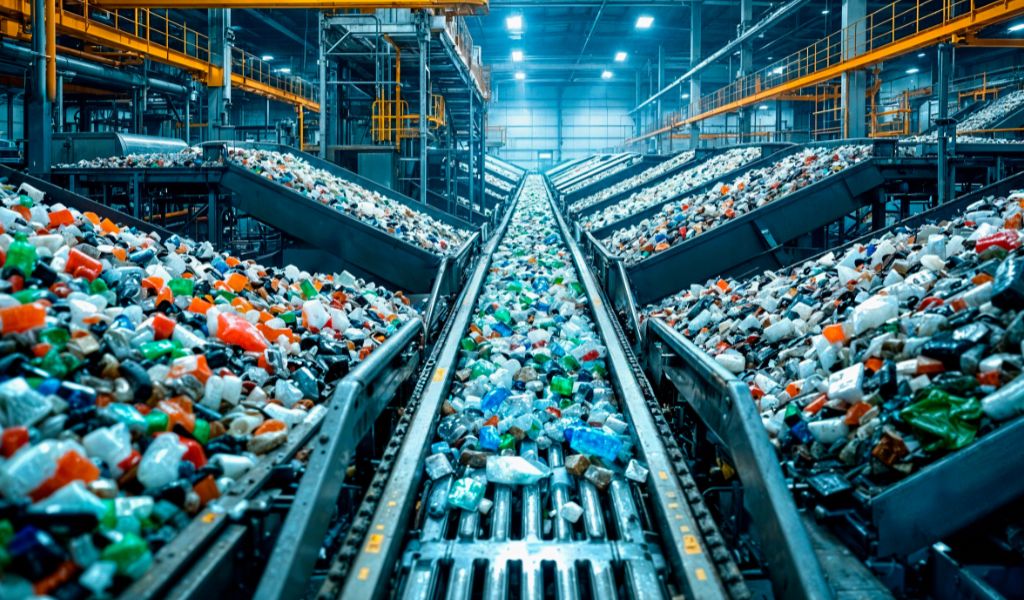
Within the global sustainability landscape, plastic waste management represents one of the most urgent and complex challenges, as not all polymers can be processed with the same ease through traditional recovery channels. While the recycling process for PET bottles is now well-established, there is a wode category of “difficult plastics,” such as multilayer packaging or contaminated polymers, that require a more advanced technological approach.
The transition from a linear to a circular economy depends on our ability to integrate advanced mechanical processes and cutting-edge chemical solutions, turning what was once unusable waste into high-quality raw materials. In this context, the use of a twin-screw extruder becomes a key element for the success of recovery operations, as its configuration allows heterogeneous materials to be processed, ensuring thorough mixing and effective degassing of volatile contaminants. Thanks to these high-tech machines, the industry is now able to restore value to plastics that, just a few years ago, were exclusively destined for waste-to-energy plants or to fill landfills.
Advanced mechanical recycling and the role of the twin-screw system
Mechanical recycling still reigns supreme for reasons of energy efficiency, but its application to mixed plastics requires a level of precision that traditional systems cannot provide. When plastic waste is sorted, ground, and washed, it often contains residual moisture or other polymers that would compromise its mechanical strength once remelted.
Twin-screw technology steps in at this stage, acting as a mechanical reactor capable of homogenizing the melt and removing gaseous impurities through dedicated exhaust chimneys. Unlike single-screw systems, this type of equipment allows much more accurate temperature control, preventing excessive heat from degrading the molecules of the recycled material and thus preserving the physical properties necessary for new industrial applications. This “upcycling” process enables post-consumer plastics to be turned into pellets ready for remolding, reducing the need to extract new oil for the production of virgin polymers.
The chemical recycling revolution for degraded polymers
Despite progress in mechanical recycling, some materials are so badly degraded that they require an even more radical process, known as chemical recycling. This technique does not simply melt the plastic but acts on its molecular structure through processes such as pyrolysis or depolymerization, which break the material down into its original monomers or hydrocarbons. Once these raw chemicals are obtained, it is possible to recreate polymers identical to virgin ones, removing the problem of contamination or loss of color quality that typical occur in of multiple mechanical cycles.
The integration of these two methods creates a closed-loop system where none of the material is lost, even facilitating the recovery of food packaging that must meet strict hygiene and safety standards. Refineries and petrochemical complexes are pouring capital into these facilities, aware that the future of the industry lies in the ability to manage waste as an inexhaustible urban mineral resource.
The synergy between design and end-of-life
For these technologies to reach their full potential, the industrial design sector should begin designing products by considering their future disassembly in accordance with the principles of eco-design. Simplifying material separation at the source means making the work of recycling machines faster and more cost-effective, thereby lowering the cost of recycled polymer. The stability of the recycling market depends, in fact, on a balance between the availability of efficient technologies and the quality of the input material, which has to be as pure as possible to avoid energy waste during the purification phase.
The revival of difficult-to-recycle plastics, therefore, is no longer a technological utopia, but an operational reality that is reshaping global manufacture toward greater environmental responsibility, thus ensuring for future generations a planet less burdened by waste and an industry capable of regenerating itself autonomously.