












Virtual Private Networks (VPNs) are essential tools for privacy, online security, and bypassing geographic restrictions.
However, there are times when you may need to temporarily disable your VPN whether to troubleshoot network errors, fix slow internet speeds, access region-specific services, or comply with certain legal restrictions.
This detailed, step-by-step guide explains how to turn off VPN temporarily in Windows 10, along with instructions for other devices including macOS, Android, iPhone, Linux, and routers.
We’ll also explore when you should and shouldn’t disable your VPN, what could happen if you do, and answer frequently asked questions.
Understanding VPNs in Windows 10
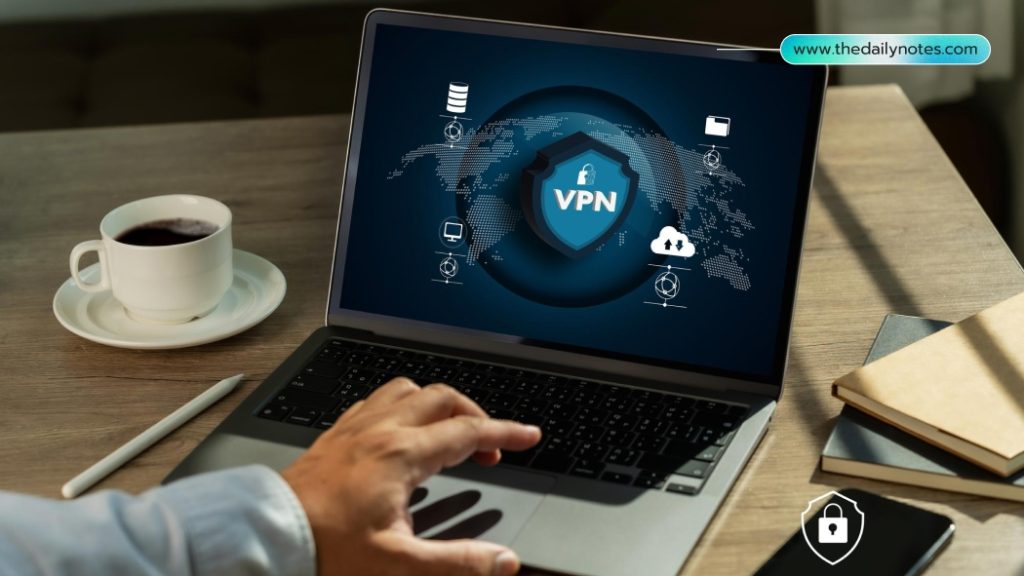
Windows 10 includes a built-in VPN client that allows users to connect to VPN servers configured manually or through workplace settings. Many users also rely on third-party VPN applications like:
- NordVPN
- ExpressVPN
- Surfshark
- Proton VPN
Before turning off a VPN, you need to know which type you’re using:
- Built-in Windows VPN
- Third-party VPN app
- Browser extension VPN
- Router-level VPN
Each requires a slightly different approach.
How to Turn Off a VPN?
The general process is simple:
- Open your VPN application or system settings.
- Locate the “Disconnect” or “Turn Off” option.
- Confirm the disconnection.
- Verify your internet connection is no longer routed through the VPN.
Let’s break this down specifically for Windows 10.
How To Turn Off VPN Temporarily In Windows 10?
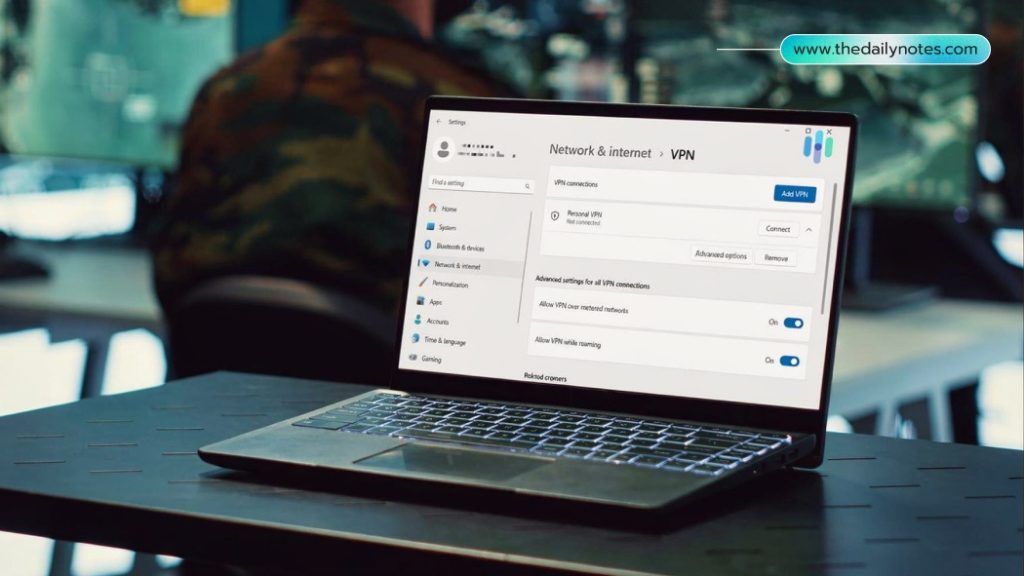
Method 1: Using Windows Settings (Built-in VPN)
Step 1: Open Settings
- Click the Start menu
- Select Settings
- Click Network & Internet
Step 2: Go to VPN Section
- Select VPN from the left sidebar
Step 3: Disconnect
- Choose the active VPN connection
- Click Disconnect
Your VPN is now turned off temporarily.
Method 2: Using Third-Party VPN Software
If you’re using a VPN like NordVPN or ExpressVPN, follow these steps:
- Open the VPN app from system tray.
- Click the connected server.
- Select Disconnect or toggle off.
Some apps include an “Auto-Connect” feature. Disable it to prevent automatic reconnection.
Method 3: Disable VPN from Network Adapter Settings
- Press Windows + R
- Type ncpa.cpl
- Right-click the VPN adapter
- Click Disable
This method forcefully disconnects VPN connections.
How to Temporarily Disable VPN on Computer?
If you only need to pause it briefly:
- Disconnect from the VPN server.
- Keep the app running.
- Avoid closing the application if you plan to reconnect quickly.
Some VPN apps include a “Pause” feature that disables connection for:
- 5 minutes
- 30 minutes
- 1 hour
Check within your VPN client settings.
How to Turn Off VPN Without It Turning Back On?
Many VPN apps have auto-connect on startup enabled.
To stop automatic reconnection:
- Open VPN app.
- Go to Settings > Auto-Connect
- Disable:
- Connect on Startup
- Connect on Wi-Fi
- Kill Switch (if needed)
Note: Disabling Kill Switch may expose your real IP.
How to Turn Off Active VPN Forcefully?
If the VPN won’t disconnect:
- Open Task Manager (Ctrl + Shift + Esc)
- Locate VPN process
- Click End Task
Or disable network adapter manually via ncpa.cpl.
How to Turn Off VPN on Windows?
To summarize for Windows 10:
- Use Settings > Network & Internet > VPN
- Or disconnect via VPN app
- Or disable network adapter
Windows also supports PowerShell commands for advanced users.
How to Turn Off VPN on macOS?
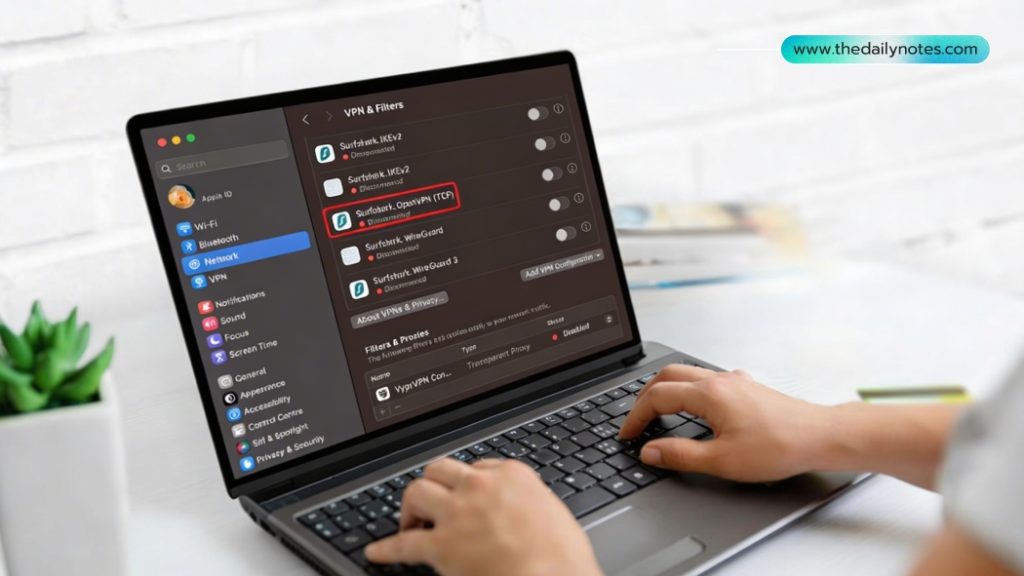
If you use a Mac:
Method 1: System Preferences
- Open System Settings
- Click Network
- Select VPN connection
- Click Disconnect
Method 2: Third-Party App
- Open your VPN app and toggle off.
- macOS includes built-in VPN support similar to Windows.
How to Turn Off VPN on iPhone or iPad?
For iOS devices:
Method 1: Settings
- Open Settings
- Tap VPN
- Toggle the switch off
Method 2: General Settings
- Settings > General > VPN & Device Management
- Disable VPN
How to Turn Off VPN on Android?
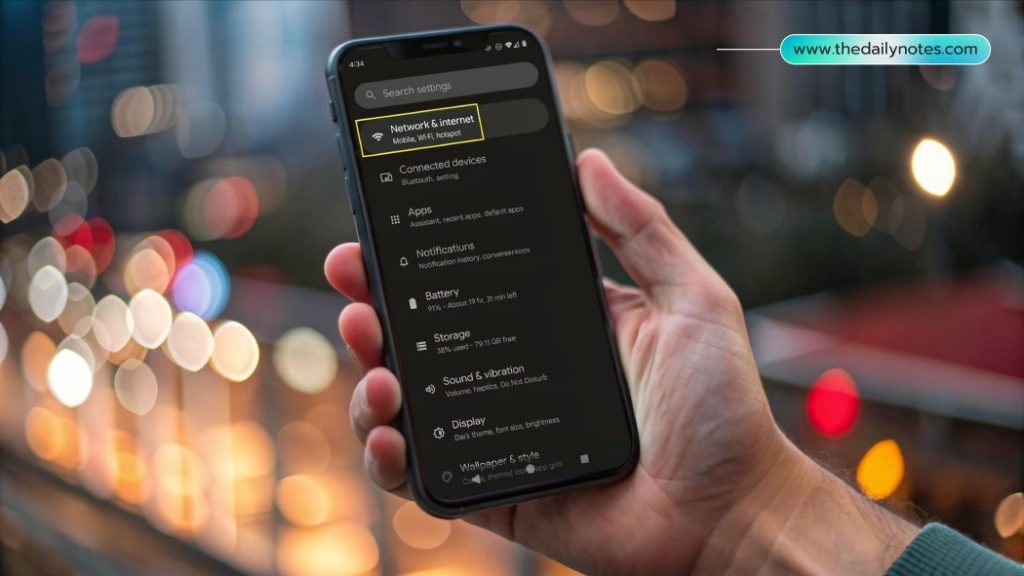
- Open Settings
- Tap Network & Internet
- Select VPN
- Tap connected VPN
- Press Disconnect
If using an app:
- Open VPN app
- Tap Disconnect
How to Turn Off VPN on Linux?
Linux users often use OpenVPN or WireGuard.
OpenVPN:
sudo systemctl stop openvpn
Network Manager:
- Click network icon
- Select VPN
- Disconnect
How to Turn Off VPN on a Router?
If VPN is configured on router:
- Access router admin panel (usually 192.168.1.1)
- Login
- Navigate to VPN settings
- Disable VPN client
This disconnects VPN for all connected devices.
When You Should Disable Your VPN?
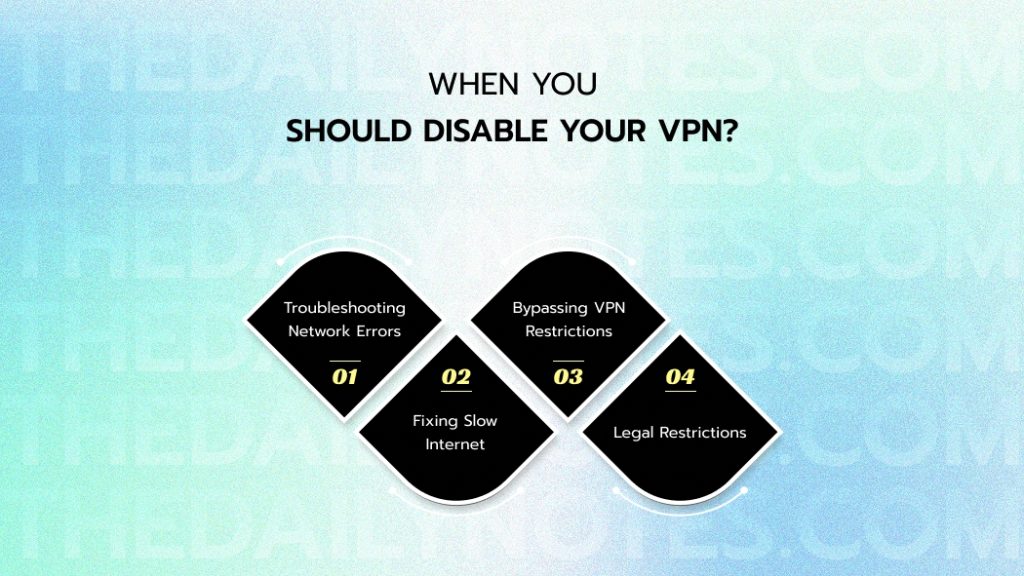
While VPNs are powerful privacy and security tools, there are specific situations where temporarily disabling your VPN makes practical sense.
Turning it off briefly can help resolve connectivity issues, improve performance, or allow access to certain services that restrict VPN traffic. Below is a detailed breakdown of when disabling your VPN may be appropriate.
1. Troubleshooting Network Errors
One of the most common reasons to disable a VPN is to diagnose internet connectivity problems.
Some websites and online services actively block VPN IP addresses. When this happens, you may experience:
- “Access Denied” errors
- CAPTCHA loops
- Login failures
- Payment processing errors
- Banking site restrictions
- Streaming playback failures
This occurs because many VPN IP addresses are shared among thousands of users, and websites often flag them as suspicious or potentially abusive.
If you’re facing:
- Website not loading
- Constant verification prompts
- Email services blocking login
- Government portals refusing access
Try temporarily disconnecting your VPN and reloading the page. If the issue resolves immediately after disabling the VPN, you’ve identified the cause.
This method is especially useful when:
- Accessing banking websites
- Logging into secure dashboards
- Using workplace portals
- Making online purchases
Once the issue is resolved, you can safely reconnect.
2. Fixing Slow Internet
VPNs encrypt your traffic and route it through remote servers. While this improves security, it can also:
- Increase latency (ping)
- Reduce download/upload speed
- Cause buffering during streaming
- Slow large file transfers
- Affect online gaming performance
This slowdown can happen because:
- The VPN server is overloaded
- The server is geographically distant
- Your ISP connection is already limited
- Encryption adds processing overhead
If your internet suddenly becomes slow:
- Run a speed test with the VPN ON
- Disconnect the VPN
- Run another speed test
If speeds significantly improve after disconnecting, the VPN is likely contributing to the slowdown.
Disabling your VPN temporarily can help when:
- Uploading large video or audio files
- Attending video meetings
- Streaming high-resolution content
- Gaming competitively
- Downloading software updates
Instead of completely disabling, you may also try switching to a closer server or using a faster protocol like WireGuard (if supported).
3. Bypassing VPN Restrictions
Some apps and services block VPN connections entirely.
These may include:
- Banking apps
- Government portals
- Streaming services
- Gaming platforms
- Delivery or ride-share apps
- Corporate networks
They do this to prevent fraud, location spoofing, or policy violations.
For example:
- A bank may block VPNs to reduce identity fraud.
- A workplace system may restrict VPN access outside approved IP ranges.
- Certain apps may refuse to function if they detect proxy traffic.
If you receive errors such as:
- “VPN detected”
- “Please disable proxy”
- “Service unavailable in your region”
Temporarily turning off your VPN may resolve the issue. After completing the task (such as logging in or making a transaction), you can reconnect for continued protection.
4. Legal Restrictions
In some countries, VPN usage is regulated or restricted.
Certain governments may:
- Limit VPN providers
- Require VPN registration
- Restrict encrypted traffic
- Block foreign VPN servers
In rare cases, using unauthorized VPN services may result in penalties. If you are traveling internationally or residing in a country with strict internet regulations, it is important to:
- Check local laws
- Understand compliance requirements
- Use approved services if required
Temporarily disabling your VPN may be necessary if:
- Government portals block VPN traffic
- Legal regulations require direct ISP access
- Certain business operations must use local IP addresses
Always prioritize compliance with local regulations.
Additional Situations Where You Might Disable Your VPN
Beyond the four major reasons above, here are a few additional scenarios:
1. Accessing Local Network Devices
If you are:
- Printing over Wi-Fi
- Accessing a local NAS server
- Using smart home devices
VPNs may interfere with local network communication.
2. Setting Up Internet Routers or Modems
Router configuration pages may not load properly when VPN is active.
3. Testing Website Location Settings
Developers and marketers may need to see how websites appear in their true region.
Important Reminder
Disabling your VPN should be temporary and intentional. Before turning it off, ask yourself:
- Am I using public Wi-Fi?
- Am I entering sensitive information?
- Am I accessing financial accounts?
If yes, it may be safer to keep your VPN enabled.
Quick Decision Guide
| Situation | Disable VPN? |
|---|---|
| Website blocking access | Yes (temporarily) |
| Slow internet speed | Yes (test connection) |
| Banking or payment errors | Yes (briefly) |
| Public Wi-Fi | No |
| Online shopping | No |
| Traveling abroad | Usually No |
| Gaming latency issues | Sometimes |
Disabling your VPN is not about compromising security—it’s about using it strategically. Turn it off when necessary for performance or access, and turn it back on when privacy and protection matter most.
When You Shouldn’t Disable Your VPN?
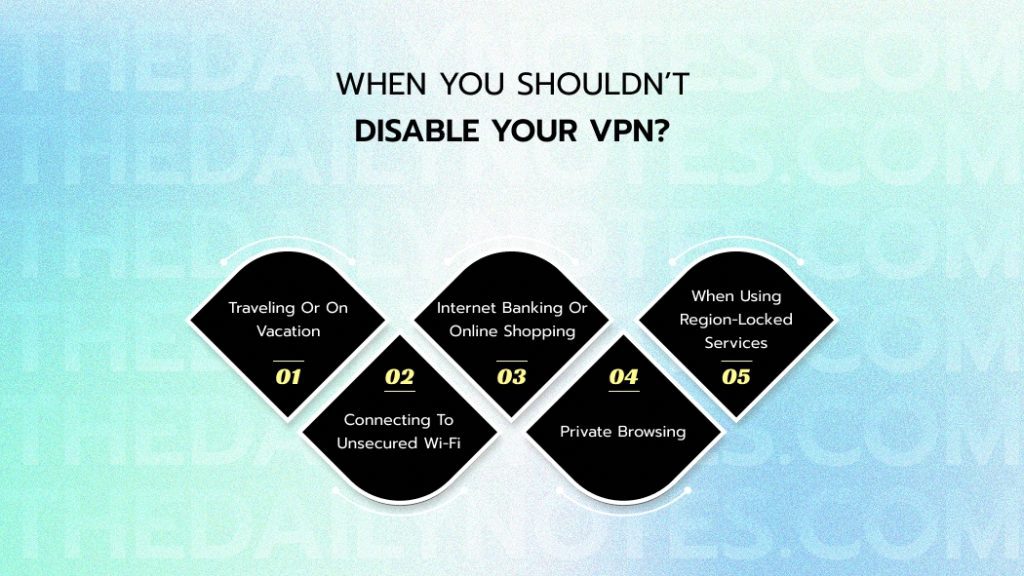
While there are situations where temporarily disabling a VPN makes sense, there are also critical moments when you should absolutely keep it enabled.
Turning off your VPN in the wrong situation can expose your personal data, browsing activity, and sensitive information.
Below is a detailed explanation of when you should not disable your VPN.
1. Traveling or On Vacation
When you’re traveling whether domestically or internationally your digital security risk increases significantly.
Hotels, resorts, co-working spaces, and shared accommodations often provide open or poorly secured Wi-Fi networks.
Even if the network requires a password, it may still lack proper encryption or monitoring controls.
Without a VPN, you risk:
- Man-in-the-middle attacks
- Packet sniffing
- Data interception
- Fake hotspot attacks
- Session hijacking
Hackers often target travelers because they assume people are accessing:
- Online banking
- Travel bookings
- Work emails
- Business dashboards
- Cloud storage
When you’re outside your home network, your VPN acts as a protective tunnel that encrypts your traffic even on insecure networks.
If you’re on vacation and accessing:
- Personal emails
- Travel booking platforms
- Social media
- Online payments
Keep your VPN enabled at all times.
2. Connecting to Unsecured Wi-Fi
Public Wi-Fi is one of the biggest cybersecurity threats.
Common high-risk networks include:
- Airports
- Cafes
- Hotels
- Shopping malls
- Libraries
- Restaurants
- Public transportation hubs
These networks are often:
- Unencrypted
- Shared by hundreds of users
- Poorly monitored
- Easy to spoof
Hackers can create fake Wi-Fi networks that look legitimate. For example:
“Free Airport WiFi” vs. “Airport_WiFi_Official”
If you connect without a VPN:
- Your passwords can be intercepted
- Your browsing history can be tracked
- Login sessions can be hijacked
- Personal data can be captured
A VPN encrypts your traffic so even if someone intercepts it, they cannot read the data. If you see a Wi-Fi network that doesn’t require strong authentication, never disable your VPN.
3. Internet Banking or Online Shopping
Whenever you’re entering sensitive financial information, your VPN should remain enabled.
This includes:
- Online banking
- Credit card payments
- Digital wallets
- Cryptocurrency transactions
- E-commerce checkouts
- Subscription services
Without a VPN:
- Your IP address is exposed
- Your browsing session is more traceable
- Your ISP can log activity
- Potential attackers on shared networks may intercept data
Even though most financial websites use HTTPS encryption, adding a VPN provides:
- An additional encryption layer
- IP masking
- Protection from malicious networks
- Reduced risk of session hijacking
Disabling your VPN during financial transactions increases exposure risk, especially on shared or public connections.
4. Private Browsing
Many users believe Incognito or Private mode is enough for privacy—but it is not.
Private browsing:
- Prevents local history storage
- Doesn’t hide your IP address
- Doesn’t stop ISP tracking
- Doesn’t encrypt your internet traffic
If you disable your VPN while browsing:
- Your ISP can see visited domains
- Advertisers can profile you
- Your location becomes visible
- Websites can track your activity more easily
A VPN protects your privacy beyond what browser private mode can do. If you’re researching sensitive topics, working on confidential projects, or simply want privacy from tracking, keep your VPN on.
5. When Using Region-Locked Services
VPNs are commonly used to:
- Access region-specific streaming libraries
- Bypass geo-restricted content
- Access websites blocked in certain countries
- Test localized website versions
If you disable your VPN:
- You may lose access to certain content
- Streaming libraries may change
- Region-locked features may disappear
- Certain websites may become unavailable
For example:
- Streaming platforms offer different content catalogs per country.
- Some business tools are only available in specific regions.
- Certain websites are blocked in restrictive environments.
If you rely on location-based access, turning off your VPN may remove that functionality immediately.
Additional Situations Where You Should Keep Your VPN On
Here are a few more situations where you should keep your VPN on.
1. Working Remotely
If you’re accessing:
- Company servers
- Shared drives
- Internal dashboards
- Cloud collaboration tools
VPN ensures secure remote connections.
2. Handling Confidential Work
Freelancers, journalists, content creators, and corporate professionals should keep VPN enabled when:
- Sending contracts
- Sharing client files
- Uploading proprietary content
- Accessing private accounts
3. Avoiding ISP Throttling
Some ISPs throttle specific types of traffic such as:
- Streaming
- Gaming
- Torrenting
- Large downloads
A VPN can prevent traffic shaping by masking your activity.
Why Disabling Your VPN at the Wrong Time Is Risky?
If you disable your VPN during high-risk activities, you may expose:
- Your real IP address
- Your physical location
- Your browsing behavior
- Login credentials
- Financial information
Even short periods without VPN protection on unsecured networks can be risky.
Quick Reference Guide
| Situation | Keep VPN On? |
|---|---|
| Public Wi-Fi | Yes |
| Online banking | Yes |
| Traveling | Yes |
| Private browsing | Yes |
| Accessing geo-locked content | Yes |
| Slow internet troubleshooting | No (temporary test only) |
| Website blocking access | Temporary disable |
What Could Happen If I Disable My VPN?
Disabling your VPN removes the encrypted tunnel that protects your internet traffic. While this may improve speed or resolve access issues, it also exposes your connection to greater visibility and potential risk. Here’s what can happen in detail:
1. Your Real IP Address Becomes Visible
When a VPN is active, your real IP address is masked and replaced with the VPN server’s IP. The moment you disconnect:
- Websites can see your actual IP address
- Your approximate geographic location becomes visible
- Your ISP can associate activity directly with your household
Your IP address reveals:
- Country
- City (approximate)
- Internet provider
- Network type
If privacy is important to you, this exposure may be undesirable.
2. ISP Tracking Resumes
Internet Service Providers (ISPs) can see your browsing activity when you are not using a VPN. While they may not always see exact page content (thanks to HTTPS encryption), they can see:
- Domains you visit
- Connection timestamps
- Data usage patterns
- Streaming activity
Without a VPN, your ISP may:
- Log browsing data
- Throttle certain types of traffic
- Analyze consumption behavior
If you rely on VPN to prevent tracking, disabling it restores ISP visibility.
3. Public Wi-Fi Risks Increase
On unsecured networks, turning off your VPN significantly raises risk levels.
Without VPN encryption:
- Your traffic may be intercepted
- Login credentials may be captured
- Session hijacking becomes easier
- Malicious hotspots can exploit your connection
If you’re on:
- Airport Wi-Fi
- Hotel networks
- Coffee shop internet
Disabling your VPN can expose sensitive data to bad actors.
4. Ads and Trackers Can Identify You
Many websites and advertisers use:
- IP-based tracking
- Behavioral profiling
- Geo-targeting
Without a VPN:
- Your IP contributes to your digital fingerprint
- Location-based ads increase
- Cross-site tracking becomes easier
A VPN adds a layer of anonymity by masking your IP.
5. Location-Based Restrictions Apply
If you were using a VPN to access region-specific content, disconnecting will:
- Restore your actual geographic location
- Limit access to certain streaming libraries
- Restrict content based on country
- Disable region-specific offers
For example:
- Streaming platforms may switch content catalogs
- Certain tools may only work in specific countries
Disabling the VPN immediately changes your digital location identity.
Does Windows Have a Built-In VPN?
Yes. Windows 10 includes a built-in VPN client. However, it does not provide its own VPN servers.
This means:
- You still need a VPN service subscription
- Or a workplace VPN configuration
- Or a self-hosted VPN server
To configure:
- Go to Settings > Network & Internet > VPN
- Click Add a VPN connection
- Enter provider credentials
The built-in client is useful for:
- Corporate remote access
- Secure office connections
- Manual server configurations
For casual users, third-party VPN apps are usually easier to manage.
Can VPN Be Switched On and Off?
Yes. VPNs are fully user-controlled.
You can:
- Turn it on before joining public Wi-Fi
- Turn it off to troubleshoot speed
- Switch between different server locations
- Change protocols
- Enable or disable auto-connect
There is no technical limitation preventing frequent toggling. However, you should use this control strategically—turning it off only when necessary.
What Is the Disadvantage of Using VPN?
While VPNs offer strong privacy benefits, they also come with trade-offs.
1. Reduced Speed
Encryption and rerouting traffic through remote servers can:
- Increase ping
- Reduce download speed
- Slow large file uploads
The impact depends on:
- Server distance
- Server load
- VPN protocol
2. Subscription Cost
Premium VPN services require:
- Monthly subscription
- Annual plan
- Multi-device licensing
Free VPNs often come with:
- Data caps
- Ads
- Slower speeds
3. Some Services Block VPNs
Websites may detect VPN usage and block access, especially:
- Banking apps
- Government portals
- Streaming services
4. Possible Compatibility Issues
Some apps, games, or local network services may not function properly when VPN is active.
Examples:
- Online multiplayer games
- Printer connections
- Smart home apps
- Corporate intranet systems
What Happens If I Leave My VPN On All the Time?
Leaving your VPN enabled 24/7 has both advantages and disadvantages.
Pros
- Constant encryption
- Protection on public networks
- Reduced ISP tracking
- More private browsing
- Less exposure to malicious traffic
For many users, especially remote workers and frequent travelers, always-on VPN is recommended.
Cons
- Slower speeds in some situations
- Increased battery usage on mobile devices
- Occasional website restrictions
- More CAPTCHA challenges
- Potential streaming library changes
If your provider has stable servers, the performance difference may be minimal.
How to Make Sure Your VPN Is Turned Off?
To verify complete disconnection:
- Check VPN app dashboard – it should show “Disconnected.”
- Visit an IP lookup website to confirm your real location appears.
- Go to Windows Settings > VPN – confirm no active connection.
- Open Network Connections (ncpa.cpl) – ensure VPN adapter is not enabled.
- Disable “Always-On” or “Auto-Connect” settings.
If your IP address matches your physical location and no VPN icon appears, it’s turned off.
Can You Pause Your VPN?
Yes. Many premium VPN providers allow temporary pause functionality.
This allows you to:
- Disable connection for a set time
- Automatically reconnect after a timer
- Avoid manual reactivation
If your VPN does not support pause, simply disconnect manually.
How Do I Turn Off Active VPN?
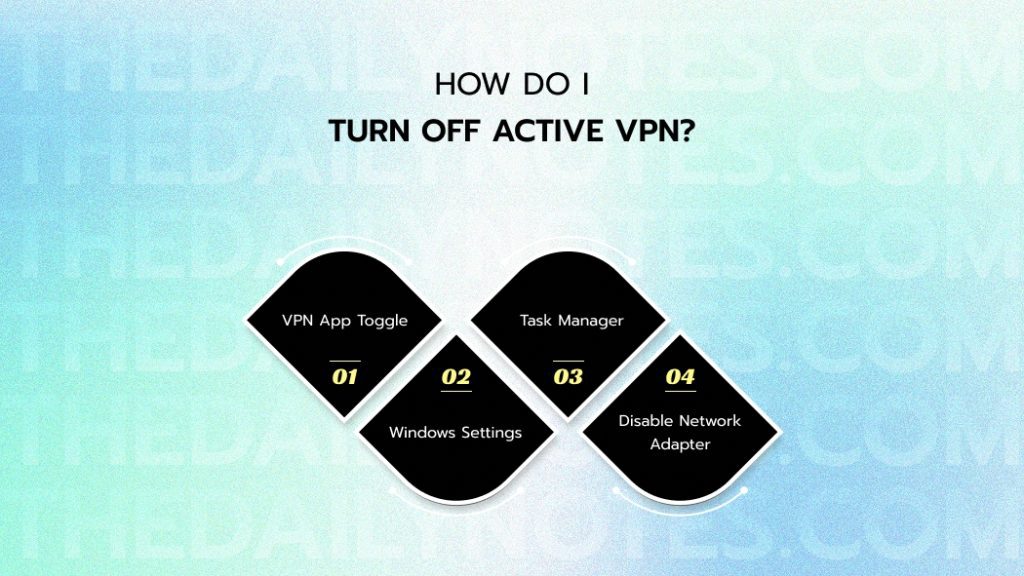
You can disable an active VPN using:
Method 1: VPN App Toggle
Open app → Click Disconnect
Method 2: Windows Settings
Settings → Network & Internet → VPN → Disconnect
Method 3: Task Manager (Force Close)
Ctrl + Shift + Esc → End VPN process
Method 4: Disable Network Adapter
Run ncpa.cpl → Right-click VPN → Disable
Each method ensures traffic no longer routes through the VPN tunnel.
FAQs
Here are a few questions and queries on the topic of how to turn off VPN that others have asked that might be helpful for you at the same time.
1. How to temporarily disable VPN on computer?
To temporarily disable a VPN on your computer, you don’t need to uninstall it. Simply disconnect from the active connection.
On Windows 10:
- Go to Settings > Network & Internet > VPN
- Select the connected VPN
- Click Disconnect
If you’re using a third-party app like NordVPN or ExpressVPN, open the app and press the Disconnect button.
This pauses the encrypted tunnel while keeping the software installed and ready to reconnect. It’s ideal for:
- Fixing connection errors
- Accessing websites that block VPNs
- Testing internet speed differences
Once you’re done, simply reconnect with one click.
2. How to turn off VPN without it turning back on?
Many VPN applications automatically reconnect due to Auto-Connect or Startup Protection settings. If you disconnect and it reconnects immediately, follow these steps:
- Open your VPN application.
- Go to Settings or Preferences.
- Disable:
- Auto-connect on startup
- Auto-connect on Wi-Fi
- Always-on VPN
- Kill switch (optional, if necessary)
On Windows 10:
- Press Ctrl + Shift + Esc
- Go to Startup tab
- Disable the VPN app from startup programs
This ensures the VPN stays off until you manually turn it back on.
3. Can you pause your VPN?
Yes, many premium VPN providers allow you to pause your connection for a specific duration, such as:
- 5 minutes
- 30 minutes
- 1 hour
This feature is different from full disconnection because:
- The app stays active
- Auto-connect resumes after the timer ends
If your VPN doesn’t have a pause feature, simply disconnect manually. However, be aware that once disconnected, your real IP address becomes visible.
4. How do I turn off active VPN?
If a VPN is currently active, you can turn it off using one of these methods:
Method 1: VPN App
- Open the app
- Click Disconnect
Method 2: Windows Settings
- Settings > Network & Internet > VPN
- Select connection
- Click Disconnect
Method 3: System Tray
- Right-click VPN icon
- Select Disconnect
You’ll know it’s turned off when:
- The VPN icon disappears
- The app shows “Not Connected”
- Your IP address reflects your actual location
5. How do I force off a VPN?
If your VPN freezes or won’t disconnect normally:
- Press Ctrl + Shift + Esc to open Task Manager
- Find the VPN app under Processes
- Click End Task
You can also:
- Disable the VPN network adapter using ncpa.cpl
- Restart your computer
- Use Command Prompt to stop the service (advanced users)
Force-disabling should only be used if normal disconnection fails.
6. Does Windows have a built-in VPN?
Yes, Windows 10 includes a built-in VPN client. However, it does not provide free VPN servers.
You must:
- Subscribe to a VPN service
- Or configure a workplace VPN
To access it:
- Settings > Network & Internet > VPN
- Click “Add a VPN connection”
This feature is useful for:
- Corporate networks
- Secure remote access
- Manual VPN configuration
Most home users prefer dedicated apps from providers for easier management.
7. Can VPN be switched on and off?
Yes. VPNs are designed to be flexible and user-controlled. You can:
- Turn them on when using public Wi-Fi
- Turn them off for faster speeds
- Switch between different servers
- Change protocols
There is no limit to how often you can toggle your VPN unless your provider restricts sessions.
8. What is the disadvantage of using VPN?
While VPNs provide privacy and security, they also have some drawbacks:
1. Reduced Internet Speed
Encryption and rerouting traffic can increase latency.
2. Blocked Access
Some streaming services and banks block VPN IP addresses.
3. Subscription Cost
Premium VPNs require monthly or yearly payments.
4. Compatibility Issues
Certain apps or games may not function properly.
5. Battery Drain (Mobile Devices)
Always-on encryption consumes more power.
Despite these downsides, VPNs remain valuable for online privacy.
6. What happens if I leave my VPN on all the time?
Leaving your VPN on continuously has both advantages and disadvantages.
Advantages:
- Constant encryption
- Protection on public networks
- ISP tracking prevention
- Improved online privacy
Disadvantages:
- Slower browsing speeds
- Potential streaming limitations
- Possible website CAPTCHA challenges
- Slight battery drain
For most users, leaving a VPN on is safe, especially if privacy is a priority.
7. How to make sure your VPN is turned off?
To confirm your VPN is fully disabled:
- Open your VPN app and verify it says Disconnected
- Check Windows Settings under VPN section
- Visit an IP checker website
- Ensure your displayed IP matches your real location
- Confirm no VPN adapter is active in Network Connections
If your location changes back to your original ISP region, your VPN is successfully turned off.
Turning off VPN in Windows 10
Knowing how to turn off VPN temporarily in Windows 10 is essential for troubleshooting, improving speed, and accessing restricted services. While VPNs are powerful privacy tools, they aren’t always necessary for every online task.
Facing troubles and facing slow browsing speed is the cause of many users, and they keep asking about how to turn off VPN.
Many users are using lookout VPN, but VPN’s functionality is slightly different from the traditional VPN.
As they only detect the Virus and block the insecure websites. So what are the problems you are facing with turning off VPNs?Do not forget to comment back to us.









All Comments
ทางเข้าUFABET
I appreciate you sharing this blog post. Thanks Again. Cool.